How to Lose Sanity in Experience Abstraction (Stay Normal Too)
On this page
Evidence and Freshness
- Historical claim evidence
- VerifiedJuly 11 observed build
- Current workflow freshness
- Needs RecheckLive build:
Quick Answer
OfficialHow to lose Sanity in Experience Abstraction: 3 official ways — isolation · darkness (very long time) · near an abstract player → risk the transform (TikTok often calls this “become the monster”). Stay normal by reversing those risks (regroup, leave darkness, step away). No published timer. Rates Unknown. Aug 20 recheck: official wording still PASS; July 11 visible UI samples stay Needs Recheck (Games API build 2026-08-18T17:34:46.689Z, not re-captured).
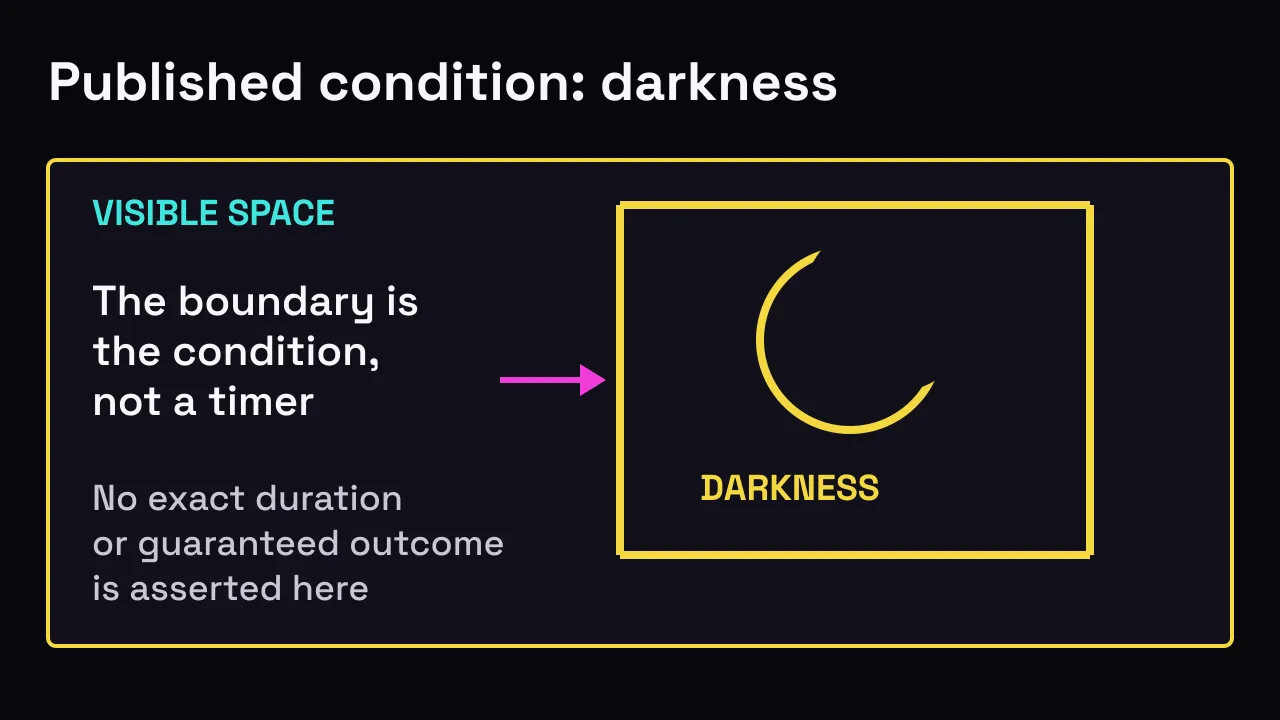
Editorial darkness diagram for Sanity risk context. Confirm lighting and any visible Sanity UI on your live server.
What Sanity Means
Players search “how to lose Sanity in Experience Abstraction” (or TikTok’s “become the monster”) for a reason: the bar (when visible) and the abstract risk are the whole game loop. The official Ways to lose Sanity text names three risks—isolation, darkness for a very long time, proximity to an abstract player—but no formula, no countdown, no ordered checklist. Treat each risk as something you can turn on or off with your feet and your lighting, then watch the character instead of guessing a number.
Aug 20 2026 editorial recheck (Games API updated 2026-08-18T17:34:46.689Z;
playing≈721): official risk wording still lists isolate / stay in the dark for a very
long time / hang out around abstracted people — PASS wording match. Rates, meters,
and July 11 UI samples were not re-captured — FAIL / Needs Recheck for visible
Sanity state. Do not treat any older timestamp as live UI PASS.
If you want how to lose Sanity on purpose (to abstract), push one risk hard. If you want to stay normal, cut the same risks as soon as you notice them.
Isolation Official means being isolated from other players is a published risk condition. Staying near the group reduces that exposure, but the official description supplies no separation threshold.
Darkness Official means remaining in darkness for a very long time is a published risk condition. Move toward a clearly lit space when you can do so without inventing a route. The wording provides no clock or brightness threshold.
The official dark-room frame contrasts a bright area with darkness. It does not establish where the condition starts, how quickly it matters, or whether servers share a boundary.
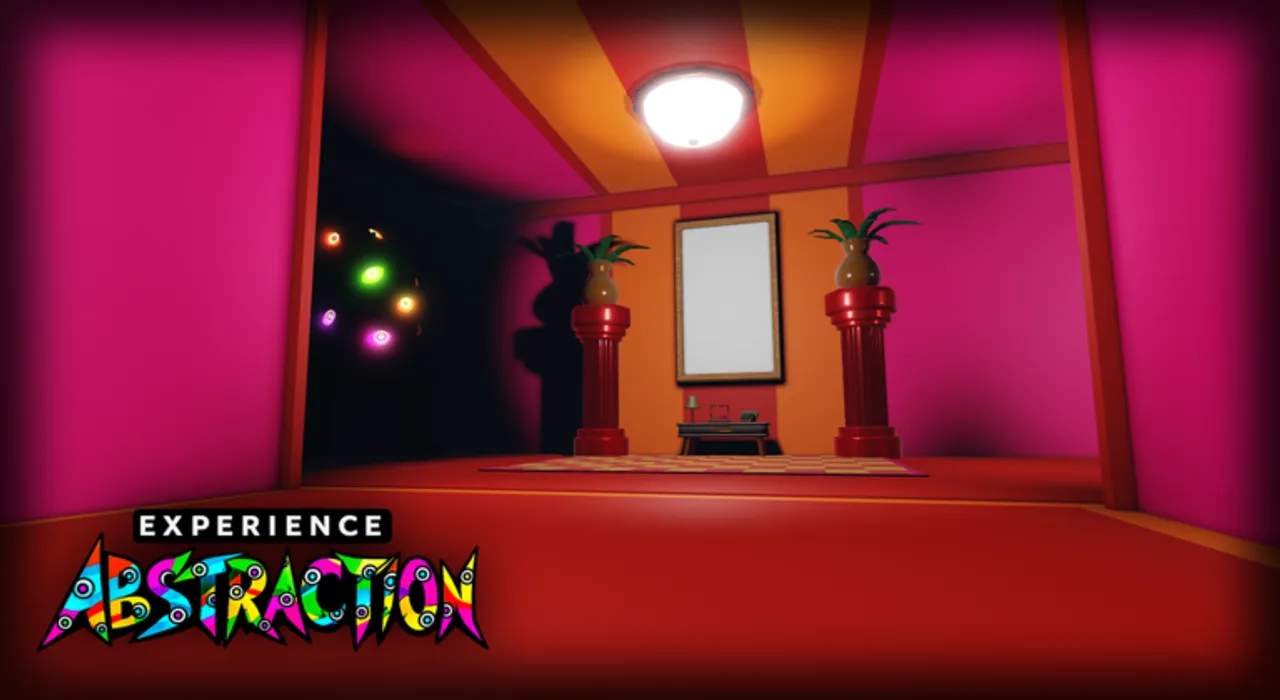
Action checkpoint: If the opening is visibly darker than your current position, move back toward the lit area and reassess. Do not wait for an assumed countdown.
Proximity Official means staying near an abstracted player is a published risk condition. Create visible space and keep checking the scene; no exact safe distance is published.
Verified July 11 Historical observation: two recorded gameplay sources show a visible Sanity state responding around these risk conditions. That dated observation remains valid as historical evidence. It is not a current-build guarantee. The live status above may mark the current build Needs Recheck, and each image carries the same version boundary.
How to Lose Sanity on Purpose
Use this only if abstracting is the goal. How to lose Sanity is the same three risks in forward mode:
- Isolation — move away from the group and keep people from walking back into your space. If someone crashes your isolation, you are not testing how to lose Sanity cleanly.
- Darkness — hold a clearly dark area. Leaving and re-entering resets what you can honestly claim about the attempt.
- Proximity — stand near a player who is already abstract. No abstract partner means this path is unavailable; switch to isolation or darkness instead of inventing a solo proximity rule.
Change one risk at a time when you are learning how to lose Sanity. Stacking all three might feel faster in a chaotic public server, but you will not know which condition did the work when something fails.
When the character transforms, you have left the “stay normal” problem and entered how to abstract success checks. If the bar or look never changes, open Troubleshooting.
How to Stay Normal
Use an exposure-reduction loop that mirrors the statements; it claims no rate or outcome.
- Check company. If you are separated, rejoin visible players rather than estimating how far away they are.
- Check lighting. Leave a clearly dark area for an obviously brighter one. Treat the visible contrast as the cue, not a hidden meter calculation.
- Check nearby players. If a player is visibly abstracted, move away and avoid following them while you reassess.
- Change one condition at a time. A single change makes the next observation useful; changing all three hides which exposure was active.
These steps reduce observable exposure; they do not promise a normal outcome or cure. Use How to Abstract to test the opposite workflow.
Warning Signals
The only verified warning signal in this evidence set is the visible Sanity state from July 11. Treat change as an observation, not a calibrated gauge; other visuals, sounds, or behavior remain unsupported. If the state differs, stays fixed, or is absent, check the freshness label before diagnosing it.
Community observation: Reported / Needs Recheck. Test the low-Sanity bed report as a diagnostic. Record visible Sanity, the build label, and whether isolation, darkness, or proximity is present; approach the bed and watch for a Sleep prompt or sleeping cutscene; capture it if shown. If nothing appears, stop and check the build. Do not infer a threshold or recovery. Aquarium, Exit Door, and glitched Caine/blue-screen sightings remain reported.
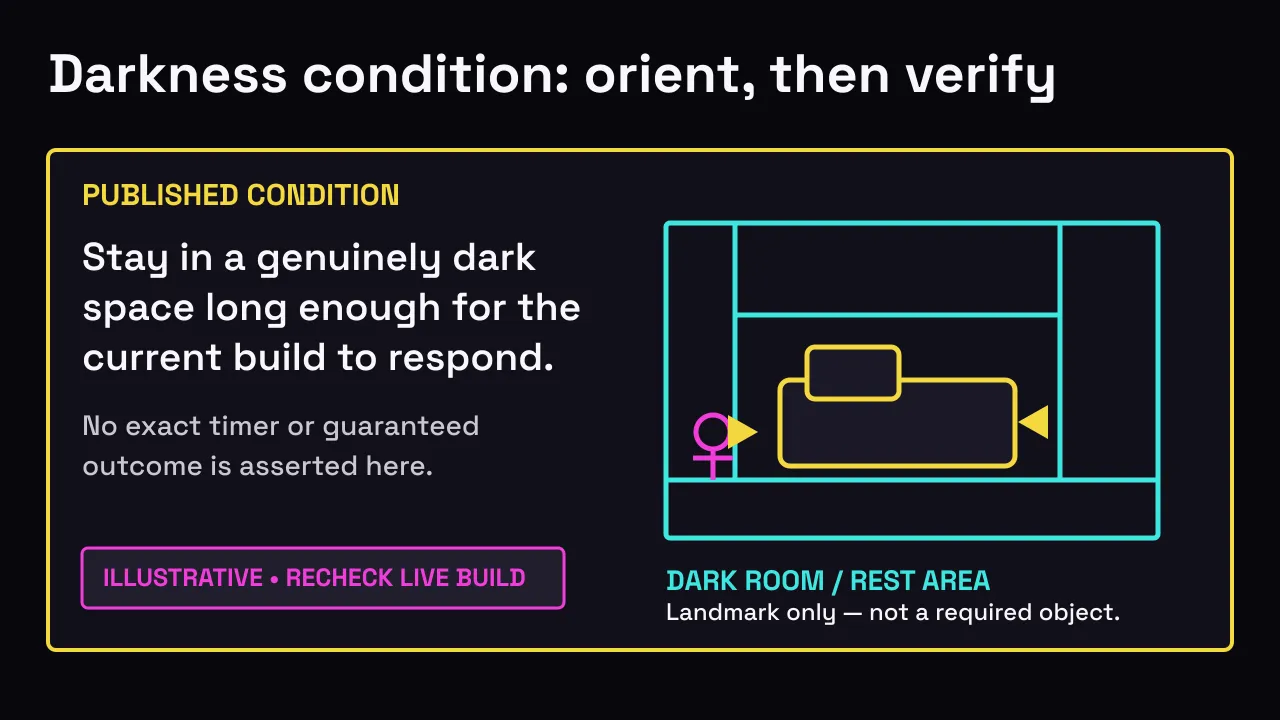
Decision checkpoint: treat the bed as an observation point, then stop if no prompt or cutscene appears.
Risk Checklist
Pause at a stable point and ask three observable questions:
- Am I isolated? Identify at least one other visible player before calling the isolation exposure reduced.
- Am I in darkness? Compare the area with a clearly brighter space; do not invent a brightness value.
- Am I near an abstracted player? Move away when one is visibly nearby, without treating any guessed distance as safe.
The site-authored checklist summarizes those questions. It does not add another condition or convert prevention into a guaranteed recovery procedure.
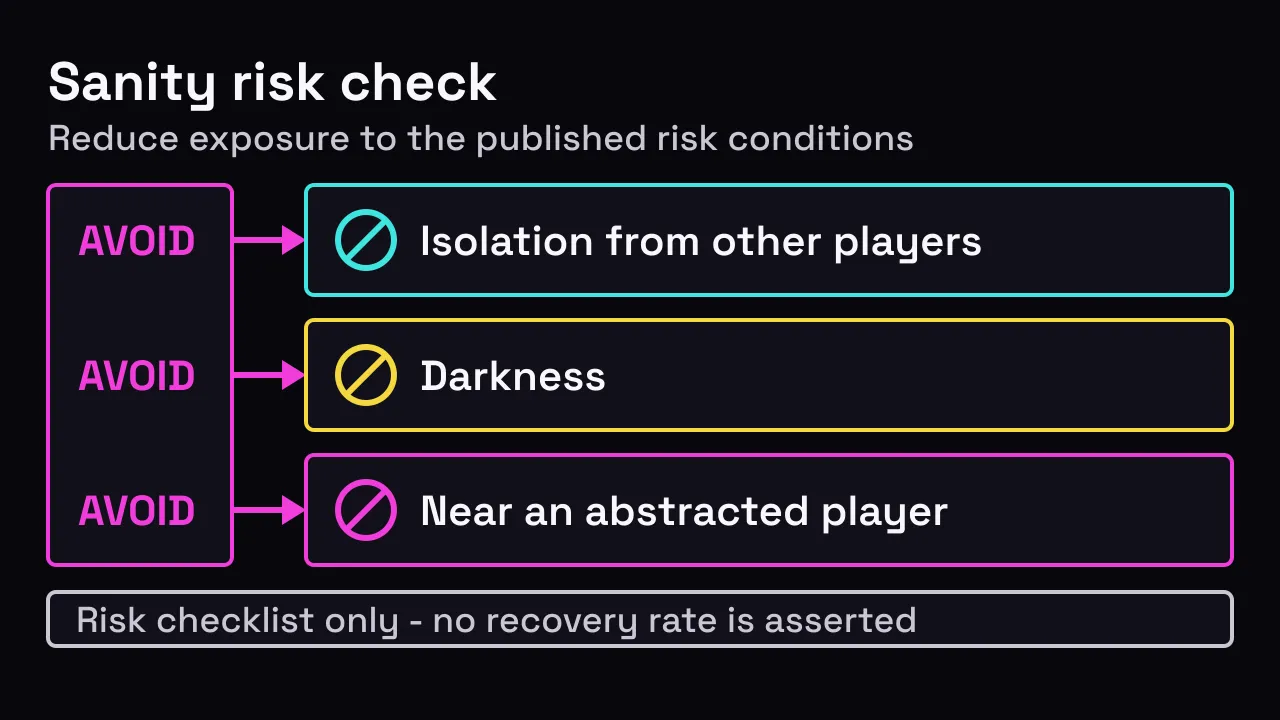
Decision checkpoint: Name the one exposure you can still see. Reduce that exposure, then observe again before changing anything else.
When Sanity Does Not Change
Use this symptom-first order instead of adding an unsupported action:
- Check the live build status. If the timestamp is newer than the July 11 evidence, keep the result at Needs Recheck and open Updates.
- Test one risk condition. Confirm that isolation, darkness, or proximity is visibly present or visibly reduced; do not mix conditions during the check.
- Watch the visible Sanity state. Record whether it changes, stays fixed, or is not present. Any of those is an observation, not proof of a hidden rate.
- Retry in a new server when practical. Server age or build differences can separate a page problem from a current-game difference, but a retry does not prove the cause.
- Record a screenshot and the build label. Preserve what happened before relying on memory or repeating the same setup.
- Use Troubleshooting. Follow its recovery order and report the observed symptom; do not add a key, item, or movement trick.
Stop after the evidence no longer supports the next step. A fixed state can mean the condition was not active, the build differs, or the behavior is still Unknown; this page cannot select among those explanations without a reproducible observation.
Unknown Rates and Recovery
- Depletion rate: Unknown. The official description gives conditions, not a formula.
- Recovery rate: Unknown. July 11 footage does not establish a current speed.
- Exact timer or threshold: Unknown. "A very long time" is not a countdown.
- Exact distance: Unknown. Near, isolated, and away have no published measurement.
- Recovery item or mechanic: Unknown. No item, input, location, or reset procedure is verified by the registered evidence.
Do not turn the absence of a verified mechanism into proof that recovery is impossible. It means this guide can recommend reducing observable exposure and documenting the result, while leaving the underlying system unresolved.
FAQ
How do I lose Sanity?
3 official ways: isolation, darkness (very long time), and proximity to an already abstracted player. Stay normal by reversing those risks. Exact rates and thresholds are Unknown. July 11 UI evidence stays Historical / Needs Recheck on the current build until a full live capture.
Can Sanity recover?
Recovery is Unknown. Reverse risk as prevention; no recovery mechanic is verified.
Does the bed or Sleep prompt restore Sanity?
No. Recovery remains Unknown. The bed/Sleep branch is Reported / Needs Recheck. Log the visible Sanity state and build; if no prompt appears, stop rather than adding a threshold or repeated interaction.
Does staying with the group stop abstraction? It reduces isolation exposure; other conditions may remain.
How bright is bright enough? No threshold exists. Compare obvious light and darkness.
How far should I move? No distance is published. Create visible separation and observe.
Why does my Sanity state not move? Check the build, isolate one condition, record the state, retry in a new server when practical, then use Troubleshooting.
Is July 11 still useful? Yes, as Historical evidence. Aug 20 recheck still PASS-checks official risk wording only; visible UI remains Needs Recheck (FAIL / not re-captured).
Where are changes tracked? Use Updates; timestamps do not explain mechanics.
Is abstraction curable?
Unknown. No verified recovery mechanic, item, or reverse-abstraction input exists here. Reversing isolation, darkness, and proximity is prevention, not a proven cure.
Is abstraction forever?
Unknown. Official text does not say the transform is permanent or temporary. Stay-normal steps reduce exposure; they do not prove a later undo.
Do “abstract fast” clips prove a short countdown?
No. AI overviews and speedrun titles invent a wait. Roblox publishes darkness as “a very long time,” not a countdown. A personal room with the lights off is still isolation plus darkness—not a fourth official method.
Sources and Verification
The source panel below keeps the official description separate from the two July 11 gameplay observations. Official evidence establishes the three risk conditions; historical video evidence establishes only the dated visible-state observation. Neither source category publishes exact rates, thresholds, distance, or a recovery mechanic.
Aug 20 retest record: Games updated 2026-08-18T17:34:46.689Z; wording PASS via description
check; Sanity visible UI FAIL / not re-captured. Workflow verification dates still point
at the July 11 baseline until a live-session capture closes them.
Sources and Verification
- Experience Abstraction on Roblox
Official Roblox description for isolation, darkness, and proximity to an abstracted player.
Checked
Official - How to Abstract in EXPERIENCE ABSTRACTION
July 11 visual evidence for a visible Sanity state; current freshness is shown above.
Checked
Verified - Current-build long gameplay
Second July 11 gameplay cross-check; it does not verify behavior after a newer live update.
Checked
Verified
Official evidence establishes the published risks. July 11 videos establish a historical visible-state observation, not a current rate or recovery guarantee.